Learn · Logic
Logic and reasoning, explained calmly — and how to practise it
Reasoning is how you get from what you know to what follows: spotting the rule behind a pattern, holding a condition in mind, and drawing the conclusion it points to. It isn't raw cleverness you're either born with or not — it's a small set of moves you can rehearse. And like any moves, they get smoother and steadier the more calmly you practise them.
What short daily practice can — and can't — do
When you practise reasoning tasks, you get reliably better at exactly those tasks — reading a condition, applying an if-then rule, checking the result — and you tend to feel sharper and more deliberate during and just after a session. That improvement is real and well supported; researchers call it near-transfer.
What it won't do is rewire your everyday decisions, or protect your brain from anything — so Facette doesn't promise that. You get good at these puzzles and enjoy a few clear-headed minutes; that's the whole offer, and it's enough.
How to practise
Keep it short and daily — five minutes you return to beats an hour you abandon after three days. Stay at your edge, where a puzzle is hard enough to make you think but solvable enough to finish. And keep it calm: reasoning works best unhurried, so read the rule once, then follow it one step at a time.
Practising this in Facette
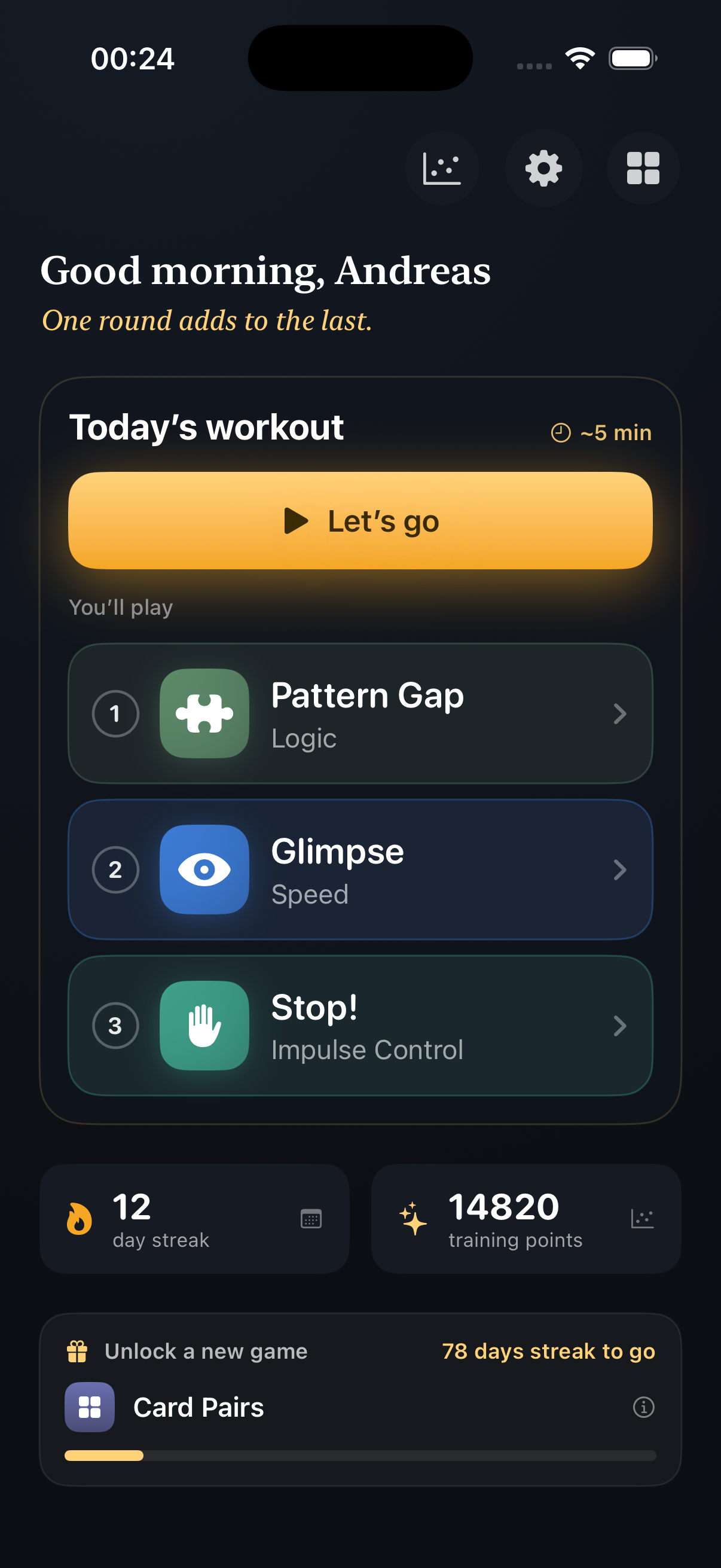
In Facette, Logic Gate hands you a simple if-then rule and a stream of inputs, and asks you to apply it — the moment where reasoning becomes a clean, repeatable move. The difficulty adapts to keep you around 80% success, and a slip is met with a calm amber, never an alarm-red buzz. It's ad-free, runs entirely on your device, and never plays itself: every conclusion is yours to draw. Five minutes for your mind — then you put the phone down.
Try Facette — free on iPhone, iPad & Mac
Questions & answers
Do brain games make you more logical?
You get reliably better at the reasoning tasks you practise and feel more deliberate during a session — that's near-transfer, and it's well supported. A higher IQ or broadly better judgement across daily life is not, so Facette doesn't claim it.
How long should I practise?
Five focused minutes a day is plenty to keep the habit going. Consistency does more for you than the occasional long session.
Is Facette free of ads and tracking?
Yes. Facette is local-first: no ads, no tracking, no analytics and no account. Your data stays on your device, with optional private iCloud sync.