Learn · Speed
Processing speed and reaction time, explained calmly
Processing speed is how quickly your mind takes something in, makes sense of it, and responds — the fraction of a second between a light turning green and your foot lifting off the brake. Reaction time is that same gap, measured directly. Neither is a fixed limit; both are more like a rhythm you can warm up, and they answer to practice the way most things do.
What short daily practice can — and can't — do
With regular short practice you get measurably quicker at the tasks you train: you catch the signal sooner, hesitate less, and respond more smoothly. During and just after a session you tend to feel sharp, alert and comfortably switched-on. That reliable, task-specific improvement is called near-transfer, and it holds up well.
It won't turn you into a faster person across your whole life, or hold off age-related decline — the evidence simply doesn't back those promises, so Facette doesn't make them. What you do get is real and pleasant: quick, capable minutes and the quiet satisfaction of a mind that's warmed up.
How to practise
Keep it short and daily — a few minutes you actually return to beats a long session you abandon. Stay at your edge, where the task is quick enough to stretch you but not so fast it turns frantic; speed grows out of relaxed readiness, not tension. And practise somewhere calm, because a jittery, punishing app trains the wrong nervous system.
Practising this in Facette
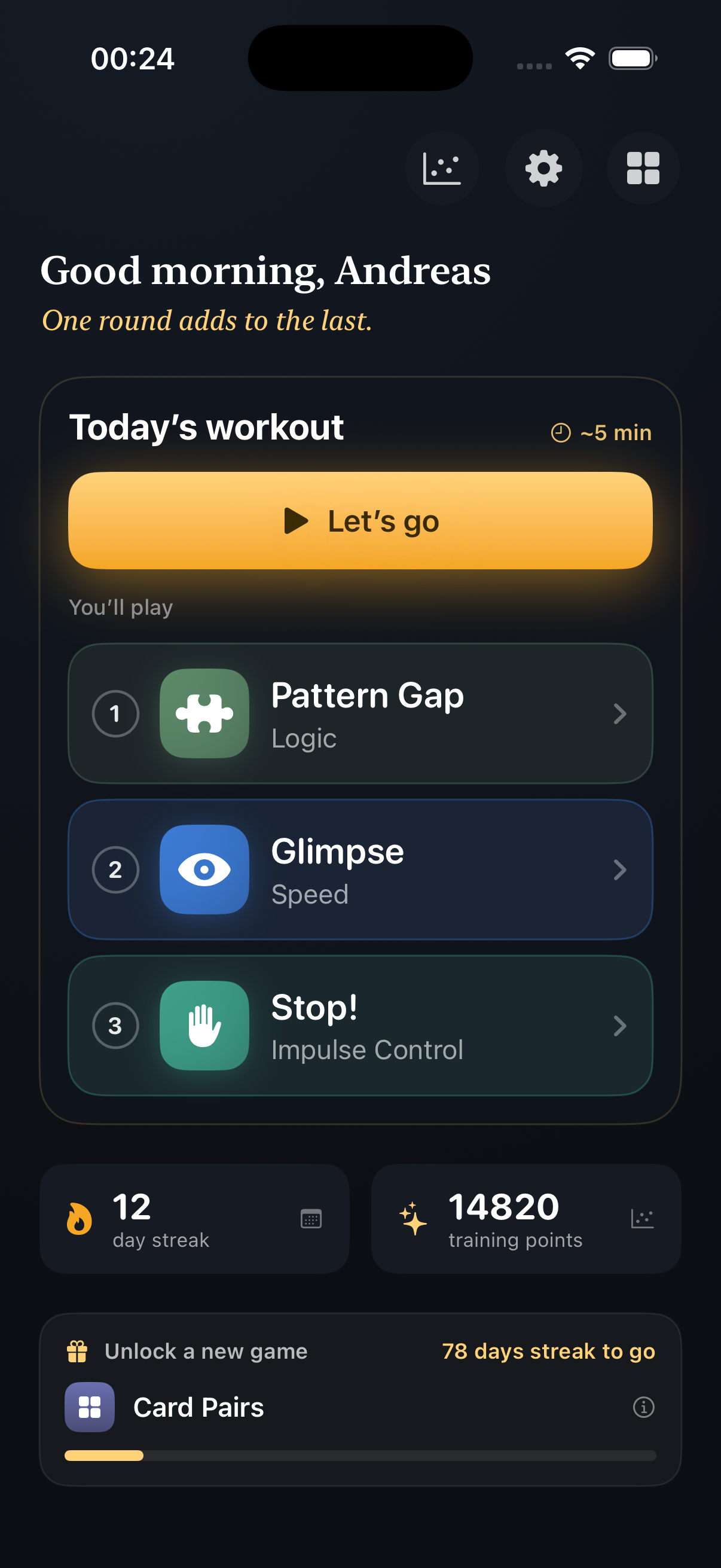
Facette gives you a few of these minutes each day across 40 short games that adapt to your level. In Light Flash you simply wait, watch, and tap the instant the circle turns green — a clean test of pure reaction time, where jumping the gun gently doesn't count. Difficulty settles around an 80% success rate so you stay quick without strain, mistakes are met with a calm amber rather than alarm-red, and the game never plays itself: every tap is yours. It's ad-free and runs entirely on your device. Five minutes for your mind — then you put the phone down.
Try Facette — free on iPhone, iPad & Mac
Questions & answers
Can brain games make you react faster?
You reliably get faster at the reaction tasks you practise, and you feel sharp and alert during a session — that's near-transfer, and it's well supported. A faster reaction across every part of life, or a higher IQ, is not, so Facette doesn't claim it.
How long should I practise?
A few focused minutes a day is plenty to keep the rhythm. Consistency does far more than the occasional long session.
Is Facette free of ads and tracking?
Yes. Facette is local-first: no ads, no tracking, no analytics and no account. Your data stays on your device, with optional private iCloud sync.